 |
Welcome!
This site contains information for anyone interested in beekeeping, honey, working with honey bees, and becoming an informed apiarist. We are finishing our 6 week Beekeeping for Fun and Profit course at Austin Peay State Univeristy (APSU) held each Tuesday evening. We are using The Beekeeper's Handbook by Diana Sammataro and Alphonse Avitabile. Special thanks go out to the TENNESSEE BEEKEEPER'S ASSOCIATION and MANN LAKE which donated hives to us for our studies and use during the class. We hope to have a crop of honey to harvest this Fall. I also want to thank B & B HONEY FARM, KELLEY BEE SUPPLY, DADANT and MID-CON for donating literature and materials for our class. PLEASE support these companies when you make purchases for your beekeeping and candle-making needs. SEE our LINKS page to see their websites.
|
Apis mellifera
Honey bees (honeybees), Apis mellifera, are an extremely unappreciated resource to our agricultural sector and economy here in the United States. It is estimated that over 14 to 19 billion dollars in agricultural products are directly affected by honeybees yearly. Without them, we would have difficulty producing crops of almonds, strawberries, cherries, cotton, blueberries, pumpkins, oranges, and watermelons to name just a select few. Every day, pesticide companies and ordinary citizens carelessly, unncessarilly, and ILLEGALLY spray and kill honey bees with pesticides. Why? They are ignorant of the benefits of honeybees, which are quite harmless unless provoked by disturbing the abode. They produce wax for candles and makeup, apitherapy for people suffering from various illnesses such as arthritis and epilepsy, honey and pollination. We are, in fact, only beginning to realize the potentially devastating effect of the loss of our feral honeybee populations caused by disease and parasitic mite infestations. |
Clarksville-Montgomery County Beekeeping Association
It is our desire to form an organization for the beekeepers of Montgomery County, Tennessee that will encourage, educate and nurture others to become knowledgeable and successful apiarists. The inaugural meeting of the Clarksville Beekeeping Association will be on June 5th 2004 at 9:30 a.m. We are still looking for a regular location for our meetings, but we will have various locations for our meetings such as local bee yards and members' homes. If you are interested in further information about becoming a member of a beekeeping club or association or would like to find out more about how to become a beekeeper, where to obtain hives for crop pollination, or who to contact to remove a swarm/colony of bees from your property please contact : jason.groppel@cmcss.net |
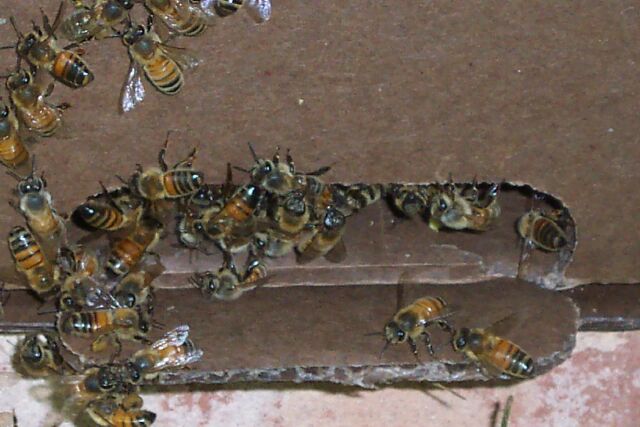
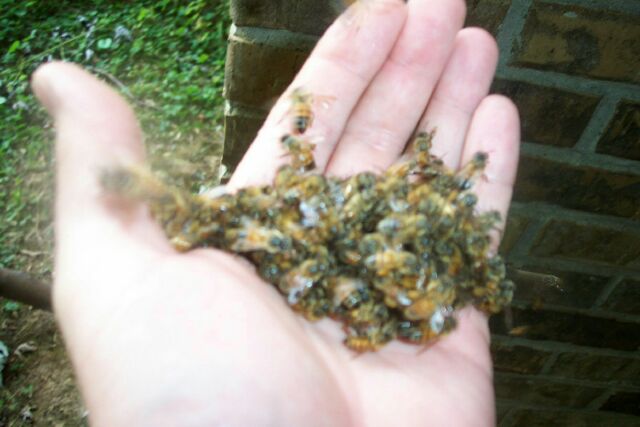
The picture above is a picture of some gentle Italian bees (Apis mellifera liguistica) in a nucleus box (nuc box) which have been split off from another strong colony in order to produce a new hive. They raise their own queen and within 3 weeks new brood appear after the virgin queen mates with local drones. To the right is a picture of some feral bees from a colony they have in a homeowner's chimney here in Clarksville, Tennessee. The gas log vent hole was cut into the brick and the bees found the space inside the chimney quite suitable as their new home. I put a box with escape cones over the entrance. I would go by often to vacuum up the festooning bees several times per week with my bee-vac that I designed and created. The BEE-VAC is used to safely remove bees without injuring them from feral (wild) colonies. In this picture I have gently cupped my hand under the bee beard they formed on the bottom of the escape box and pulled them free from their formation. Some of them are starting to take flight out of my hand. Pictures by Jason Groppel - 2003
|
|


